Unlocking Opportunities
At the Intersection of AI and DeFi
Date of Publication
November 2024
Author
Charlie Kellaway
Reading Time
13 minutes
Introduction
The world is changing, exponentially. Artificial Intelligence (AI), the concept of enabling a machine to mimic cognitive functions associated with human intelligence, advances at blistering pace, with subsets of machine learning, natural language processing and deep learning impacting economic activity across almost every industry. It is expected that AI will soon integrate with all systems and devices to optimise human behaviour, creativity and performance [1].
Financial markets, historically a frontier for technological experimentation, will be greatly affected. Certain institutions have built out machine learning techniques for some time: high-frequency traders, for example, have pushed technological boundaries with algorithms to reduce latency to mere microseconds. However, many firms are yet to fully embrace AI in their operations.
This presents opportunity for decentralised startups. Decentralised finance (DeFi) – a financial system using blockchain for peer-to-peer transactions – can capitalise and entrepreneurs are aggressively pursuing a paradigm shift to eliminate intermediaries in trade and lending. Since both AI and DeFi are driving forces behind the digital revolution, many consider that AI can accelerate DeFi’s vision.
Investors are alert to this and recent venture capitalist (VC) activity targets companies at the forefront of experimentation, betting that synergies will compound capabilities. We explore what is possible at this intersection and consider why investors are so excited.
The Frontier of a Digital Revolution
The digital revolution captures the shift from analogue, mechanical devices to digital technology that integrates Internet-based tools into our everyday lives [2]. It has transformed the way we live, work and communicate by making services more accessible and keeping us constantly connected.
DeFi will accelerate this. DeFi empowers users to access financial services that would not otherwise be available through centralised financial institutions, leveraging features of blockchain technology to support trustless peer-to-peer transactions between two users anywhere in the world. These features – smart contracts and oracles – remove the need for intermediaries, reducing trading costs and transaction times [3].
Originally conceived in 1997, smart contracts are lines of code that execute in a distributed, automated manner when conditions of the code are met [4]. Blockchain is the optimal platform for smart contracts because it supports oracles, which bridge decentralised systems and third-party sources to integrate real-world data with decentralised applications (dApps) [5]. Sport, weather, political and macro event data can all stream into smart contracts, making DeFi interoperable with the real world.
Consider that two DeFi users make a peer-to-peer bet on a football match, pledging crypto tokens on the outcome. A smart contract facilitates this: If Team A wins, Player 1 receives tokens. If Team B wins, Player 2 receives tokens. If teams draw, return respective tokens to players. An oracle inputs the match outcome, and the contract immediately executes the correct transaction, without an intermediary to oversee settlement.
Automated execution is vital as it supports interoperability, scalability and, ultimately, utility of blockchain. The more efficiently a blockchain can execute smart contracts, the more value it provides users and the more attractive it is as a network. It is therefore crucial for DeFi applications to efficiently receive high-quality, accurate data.
But automation is also associated with another revolutionary technology. Since ChatGPT-3 launched in 2022, AI has been the buzzword across all sectors and is now considered more powerful and viable than blockchain [6]. And since AI shows exceptional performance in a range of tasks (Table 1), it has widespread and accelerating relevance [7].
| Form | Description | Uses |
|---|---|---|
| Generative Adversarial Networks | Two neural networks – a generator and a discriminator – are trained in opposition to each other. The generator creates synthetic data, and the discriminator evaluates authenticity compared to real data, iteratively improving output to align the quality of synthetic with real. | Image and video generation. Synthetic data generation to test trading algorithms and stress-test financial models. Train fraud detection systems with synthetic fraudulent transaction patterns. |
| Variational Autoencoders | Probabilistic models that learn to encode input data into a latent space, then generate diverse outputs by sampling from this space and decoding back to the original space. | Synthetic data generation to train other models. Anomaly detection to indicate fraudulent activities or errors. Portfolio optimisation by generating and analysing different scenarios to assess potential strategy outcomes. |
| Transformers | Pre-trained on vast textual datasets and fine-tuned for specific tasks, enabling them to create coherent and contextually relevant text. Example: Generative Pre-trained Transformers (GPT). | Natural Language Processing (NLP), including chatbots. Code generation based on natural language inputs. Automated reporting, summaries. |
| Neural Style Transfer (NST) | NST leverages convolutional neural networks to apply the visual style of one image to the content of another. | Advertising. Customised reporting. Dashboards, data visualisation. |
| Reinforcement Learning-based Generative Models | RL models use reward-based mechanisms to generate content. Through trial and error, feedback on model performance directs the generation of desired outcomes. | Algorithmic trading strategies, learning from simulations to optimise for financial rewards. Robotics training to improve autonomous performance. Simulate risk scenarios to generate mitigation strategies. |
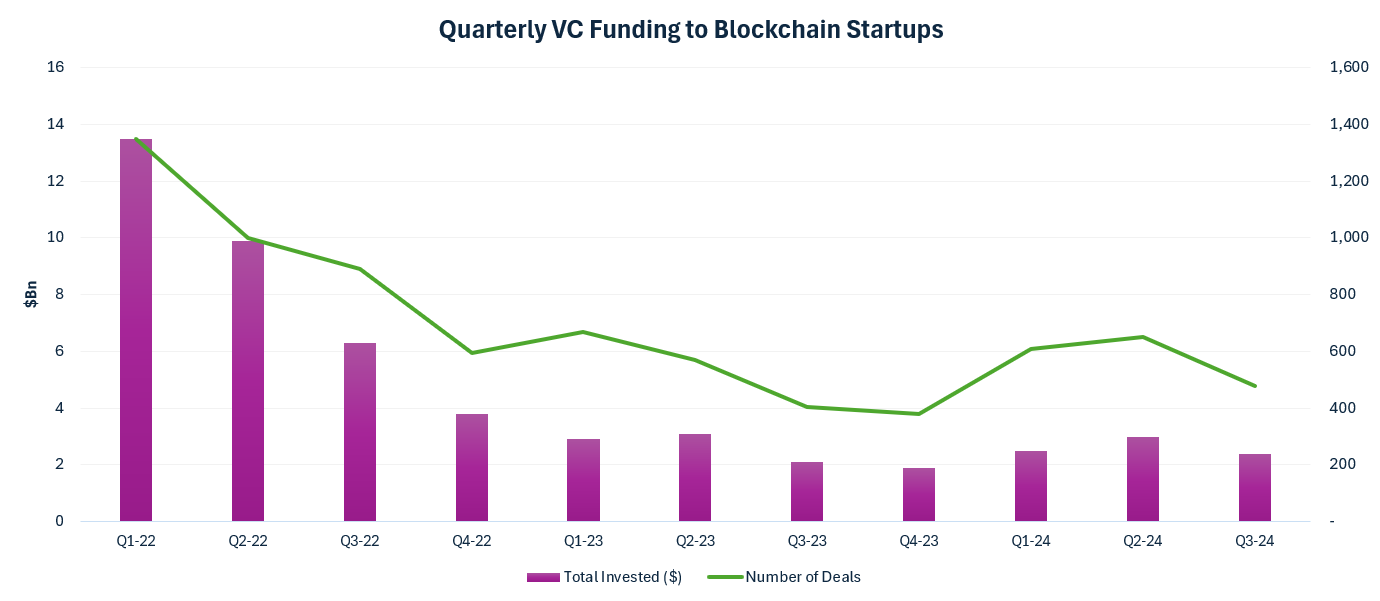
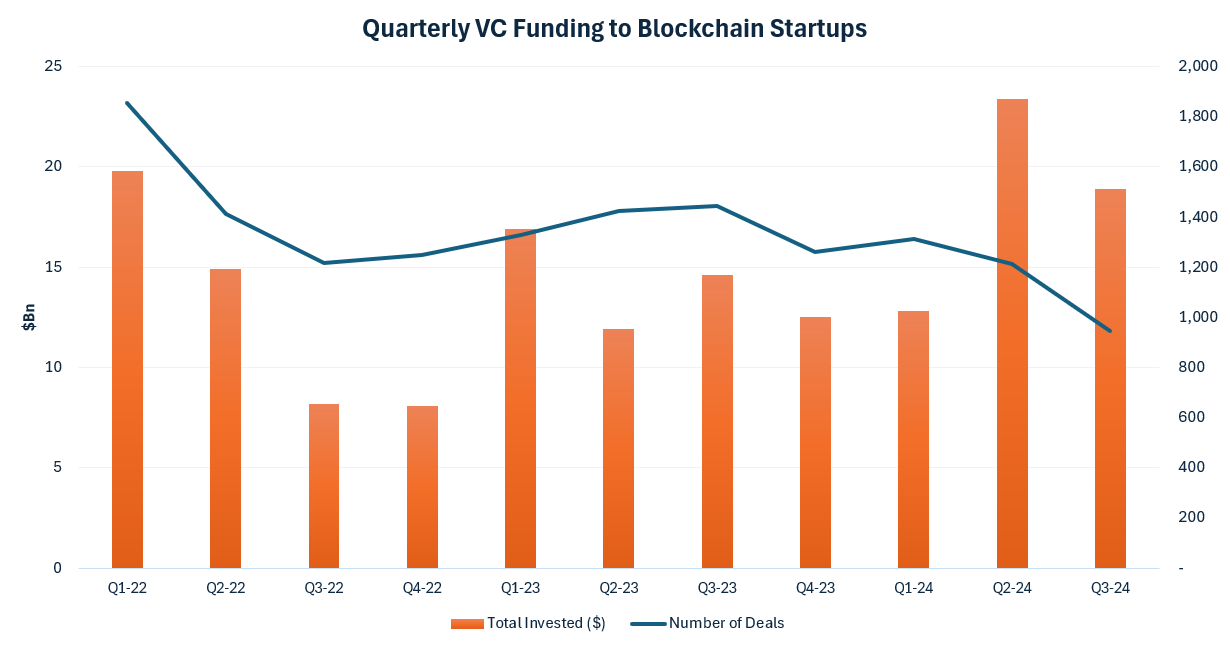
The excitement around AI and its applicability to almost every industry has limited recent funding offered to blockchain projects, likely diminishing the public relevance of DeFi (Fig. 1, 2). However, AI faces issues of its own. Firstly, developmental capability is tied to centralised infrastructure [8]. A small group of behemoths (Meta, Google, Amazon, Microsoft and Apple) wield computational resources worth billions and continually invest in the best resources, whilst smaller players are increasingly limited and find their abilities restricted. Centralised, consolidated power risks establishing insurmountable competitive barriers that limit the diversity of offerings.
Secondly, data is vital. AI must be trained with quality data, but research suggests that AI may exhaust all current high-quality language data available on the internet as soon as 2026 [11]. This poses a major problem, since the rate of learning may be constrained by the ability of humans to publish more data.
To counter, AI developers will likely leverage their power over users. Google, for example, has considered user data from Google Docs and Google Sheets [12]. In fact, companies have already scraped data from the web and social media for large-scale training, which raises questions around ownership and fairness [13]. Creators are not compensated for the use of their data, yet the bulk of benefits accrue to a small group of resourceful companies.
So, on one hand, DeFi relies on healthy input data to enact automated contract execution but is overshadowed by the pace and popularity of AI. On the other, AI faces a shortage of data, and centralisation risks the quality of future products.
The stage is set to explore their collaboration.
Integrating Technologies, Synergising Benefits
Integrating AI with DeFi largely centres on technical enhancements to blockchain security, efficiency and functionality. The pre-eminent way to do this creates AI-coded smart contracts [14].
At their core, AI-coded smart contracts support dynamic decision making. Traditional smart contracts are static, executing predefined actions based on predetermined conditions [15]. Input A leads to outcome 1, and so on. A contract will not execute if it does not receive a specific input. In contrast, AI-coded smart contracts can respond to live data. Transformers (Table 1) can analyse vast quantities of data in real-time, including sentiment, price trends and events, and feed concise outputs directly to smart contracts. For example, summarising news to identify key information which, given to a smart contract, will initiate execution. Or a decentralised lending application may leverage AI to adjust interest rates based on a borrower’s credit score or economic conditions. Or an insurance protocol might use AI to assess risk factors and adjust premium rates in real-time. AI can accelerate the speed or adjust the instance in which a smart contract will pay out, optimising processing and supporting more versatile outcomes.
The ability to translate natural language means transformers can facilitate communication between humans and blockchain, and the list of DeFi activities this supports is diverse and extensive. At the very least, AI-coded smart contracts can:
- Automate rebalancing in-line with an investor’s goals and risk tolerance.
- Simulate different scenarios to stress test event impacts on portfolios.
- Automate market making and support liquidity by using machine learning to predict supply and demand.
- Automate complex transactions (e.g., derivative trading or loan origination) when counterparties meet conditions for trade.
- Perform sentiment analysis to integrate news or social media with trading strategies.
- Examine historic data to assess credit risk, market risk, liquidity risk and more, and adjust smart contracts accordingly.
- Customise financial products by analysing user preferences & actions.
- Streamline real estate transactions by automating payments and verifying titles.
- Use oracles to automatically track inventory levels and optimise supply chains.
- Automate routine legal tasks (e.g., contract reviews) to precisely execute agreements.
- Convert complex legal documents into smart contracts.
- Support basic users to create smart contracts with natural language inputs.
- Assess risk factors in DeFi ecosystems to mitigate risks and improve the robustness of smart contracts.
- Ensure contract compliance with regulation to reduce market abuse.
Ultimately, DeFi ecosystems prosper as AI facilitates more strategic transactions, with and without human interaction. But benefits do not accrue solely to blockchain. AI needs vast, quality datasets to learn, and data is abundant in decentralised ecosystems.
Consider the core principles of blockchain. Decentralisation of data eliminates central authorities and prevents a single point of failure. A transparent public ledger reduces the risk of data censorship. And immutability prevents data tampering. So, blockchain securely stores large quantities of data that is visible to everyone, making it an ideal source for training deep learning models. Quality is also key, and blockchain’s immutable and transparent ledger ensures a high standard of data [16, 17]. Studies have successfully used blockchain to share locally collected data and address the explainability challenges of neural networks, given the transparency and quality available [18]. Blockchain’s features can address the potential shortage in high-quality data.
Of course, there are challenges. Regulatory frameworks for both AI and blockchain are evolving, which creates uncertainty for entrepreneurs. It seems likely that either technology, or both, will be considered ‘high risk’ under regulation such as the EU AI Act, introducing the possibility that commercial products will need to be altered to comply with subsequent regulation [19]. And projects may need to meet divergent regulation across jurisdictions, considering likely focus on information privacy. This is a crucial, yet complex task and the development of AI-coded smart contracts requires highly specialised expertise to adhere to privacy requirements. But the biggest problem concerns scalability, which impacts the capacity of both technologies to handle increased workload without compromising performance [20]. AI imposes substantial computational resource for training and inference that can increase latency when deployed on blockchain [21]. Consequently, developers will need to solve for optimal performance that balances AI computational requirements and blockchain limitations.
However, success on this frontier should cultivate value. Blockchain’s features encourage diverse participation and decentralise access to computational resource, promising an alternative method for AI development that challenges monopolistic control. As early as 2022, the decentralised web had already unlocked more computing power than the tech giants, with Bitcoin alone exceeding 100x Google, Amazon and Meta combined [22]. Open development will bring significantly more diverse contributions than a single, centralised entity.
Noting the potential, there has been growth in the number of projects integrating the two (Table 2).
| Platform | Product | Use of AI |
|---|---|---|
| Aave | Decentralised lending system that allows users to lend, borrow and earn interest on crypto assets. | Integrates AI to analyse market conditions and adjust interest rates for lenders and borrowers. The model can assess user credit ratings through transaction history to reduce default risk and improve stability of the platform. |
| Artificial Superintelligence Alliance | Pooled resource and expertise of Fetch.ai, SingularityNET and Ocean Protocol to foster innovation and inclusivity in AI development. | Largest open-sourced, independent entity in AI research and development, inviting global user interaction. |
| Chainlink | Decentralised oracle network that provides blockchains with real-world data and off-chain computations. | AI-powered oracles feed data to smart contracts, improving accuracy by aggregating and verifying data from multiple sources. Oracles are optimised to detect anomalous data that compromises integrity of contract executions. |
| Compound | Decentralised protocol allowing users to deposit crypto into lending pools for borrowers. Lenders then earn interest on the assets they deposit. | Uses AI to optimise yield strategies and manage risks. Algorithms analyse market trends and liquidity conditions to suggest optimal yield farming strategies and can adjust strategies in real-time to protect user assets from adverse market conditions. |
| Guru Network | Integrates traditional business engines with AI to support the creation of Web3 and AI applications. | Deploys co-pilot solutions to support development of blockchain code. |
| Gensyn | A decentralised marketplace for GPU compute to train machine learning models, supporting alternatives to centralised operational control. | Anyone can contribute GPU compute, from personal computer to idle data centre, to train a model or run inference. |
| Uniswap | Decentralised exchange with AI-Driven Automated Market Making. | AI is crucial for optimising liquidity provision and trading efficiency. Models analyse trading patterns and liquidity to ensure the correct distribution of assets in pools. This ensures traders can always find liquidity. |
Where Investors See Value
Finding alpha in a world run by a Big Tech cartel would be extremely challenging. So, investors are motivated to prevent centralised control of AI and have identified opportunity in startups creating decentralised networks to unlock computing resource. The median blockchain-focused VC fund size has increased 65.1% to $41.3m across 2024 and the number of midsized funds worth $100-500m has also increased [23].
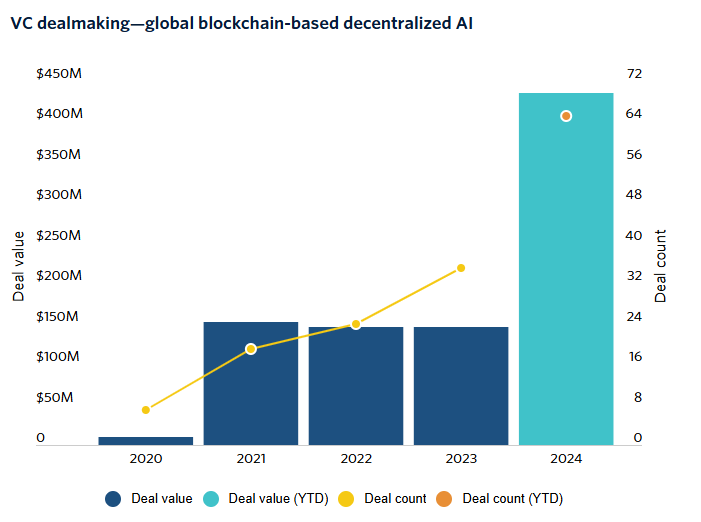
Source: PitchBook
Crypto-cum-AI startups have received the most attention. Several VCs, including Coinbase Ventures, Outlier Ventures and Fabric, have released theses detailing how crypto’s efficiency, transparency, immutability and programmability can combine with AI to a) transform how humans and machines interact with the digital economy, and b) encourage large-scale participation [24, 25]. In October, investment manager VanEck launched a $30m fund to support the sector and a total $435m has been raised for crypto x AI startups this year (Figure 3) – as much as the previous three years combined [26, 27]. Funded startups include:
- Sentient: $85m to build an open-source AI development platform on Polygon.
- Ceti: $60m to make AI systems interoperable across blockchains.
- Sahara AI: $43m to build an AI blockchain.
- Flock: $6m to build a platform for decentralised data, computation and models.
VanEck estimate that crypto x AI revenues could hit $10.2bn by 2030 [28]. Reasoning that open-source communities (containing hobbyists and enthusiasts motivated to drive change) can outmanoeuvre centralised thinking is firmly baked into their projections. Investors recognise that decentralised systems promise value because users retain ownership of their data and monetise contributions to training models. Blockchain participants and AI models both prosper from synergies, creating value for the whole ecosystem.
There is also value in disrupting traditional business models. Between 2014-22, the top 10 Exponential Organisations oversaw an average increase in market cap of 900%, compared to 250% by S&P companies [29]. These organisations included Etsy, Reddit, Google, Uber, Airbnb and GitHub; all disrupted incumbents by digitalising operations and decentralising and democratising their product.
An ExO [exponential organisation] is a purpose-driven, agile and scalable organisation that uses accelerating technologies to digitize, dematerialize, democratize, and demonetize its products and services, resulting in a 10x performance increase over its non-ExO peers.
Salim Ismail, Peter H. Diamandis & Michael S. Malone
Incumbent financial institutions face great risk of disruption, since traditional channels are failing to meet the needs of end users. Consider, for one, the lengthy chain of intermediation. Between a listed company and savers are custodians, nominees, investment banks, asset managers, fund-of-funds, HFTs, consultants, insurers, advisors, platforms and exchanges. Many intermediaries, if not all, take a cut of each trade, prioritising their commercial objectives over the objectives of businesses and households for whom the system was built [30]. This has degraded trust – a crucial element. Consumer sentiment accounts for 13-26% of GDP decline, so without a trusted, effective financial system, it is impossible to ensure macroeconomic stability [31]. But financial markets have been low trust environments at least as far back as 2008 [32]. In 2012, 71% of British adults did not think that banks had learnt their lesson from the financial crisis and customers rated just 2% of US financial services brands “strong” on trust in 2022 [33, 34].
Regulation has sought to boost trust through transparency and liquidity initiatives. But this incurs administrative costs and constrains engagement, exemplified by markedly better performance of closed-end (managed) investment funds than open-end (transparent) funds with identical objectives [34]. In traditional finance, costs are passed to end users.
Financial services need simplification to establish short, simple, transparent chains between users that give households and businesses ownership. Investors know that DeFi technology, optimised with AI, can provide this, displacing traditional business models.
Closing Remarks
AI and DeFi are, in their own ways, accelerating the digital revolution. Each offers value in trade, finance and supply chains and has attracted significant investment. But the greatest opportunities synergise the two.
Where blockchain struggles for relevance, AI can bring dynamism to ecosystems and support interoperability between protocols and the real world. AI can make smart contracts versatile and, subsequently, DeFi products more bespoke. Now is a great time to be thinking about what a powerful blockchain may look like.
Equally, AI is in danger of becoming a closed shop, developed by select companies that train models with customer data and reap the benefits. But blockchain unlocks decentralised computer resource and transparent, quality training data to disrupt this model.
Finding new ways to construct business propositions can have a transformative impact on economies, businesses and households. In each other, AI and blockchain find solutions to their flaws that allow them scale and bring value to creators, investors and users.
[1] Ismail, S., Diamandis, P. H., & Malone, M. S. (2023). Exponential Organizations EXO 2.0. Powell: Ethos Collective.
[2] Beal, V. (2024). Digital Revolution. Available at: Technopedia (Accessed: 10 November 2024).
[3] Sharma, R. (2024). What Is Decentralized Finance (DeFi) and How Does It Work? Available at: Investopedia (Accessed: 07 November 2024).
[4] Szabo, N. (1997). The idea of smart contracts. Nick Szabo’s Papers and Concise Tutorials, 6.
[5] DecntAI Blog. (2024). Blockchain Oracles: Bridging External Data Sources with AI Smart Contracts. Available at: Medium (Accessed: 16 October 2024).
[6] Heaven, W. D. (2023). The inside story of how ChatGPT was built from the people who made it. Available at: MIT Technology Review (Accessed: 09 November 2011).
[7] Ressi, D., et al. (2024). AI-enhanced blockchain technology: A review of advancements and opportunities. Journal of Network and Computer Applications, 225, 103858.
[8] DecntAI Blog. (2024). Exploring the Synergy: Blockchain’s Role in AI Advancement. Available at: Medium (Accessed: 16 October 2024).
[9] Thorn, A., & Parker, G. (2024). Crypto & Blockchain Venture Capital – Q3 2024. Available at: Galaxy (Accessed: 10 November 2024).
[10] van Romburgh, M. (2024). These 10 Charts Show Startup Funding Downturn Continues Despite AI’s Ascent. Available at: Crunchbase (Accessed: 10 November 2024).
[11] Villalobos, P., Ho., A., Sevilla, J., Besiroglu, T., Heim, L., Hobbhahn, M. (2024). Will we run out of data? Limits of LLM scaling based on human-generated data. Epoch, University of Aberdeen, MIT, CSAIL, Centre for the Governance of AI, University of Tubingen.
[12] Rao, D. (2024). All-powerful, ever-pervasive AI is running out of internet. Available at: The Week (Accessed: 18 October 2024).
[13] Open Rights Group. (2024). ICO fails UK Meta users and allows social media giant to resume data scraping for AI. Available at: Open Rights Group (Accessed: 09 November 2024).
[14] DecntAI. (2024). Decentralized Finance (DeFi) Integration: Leveraging AI for Financial Innovations. Available at: Medium (Accessed: 16 October 2024).
[15] LCX Team. (2024). AI Coded Smart Contracts Explained. Available at: LCX (Accessed: 17 October 2024).
[16] Shah, K., Patel, N., Thakkar, J., & Patel, C. (2022). Exploring applications of blockchain technology for Industry 4.0. Materials Today, 62(13), 7238-7242.
[17] Soori, M. Dastres, R., & Arezoo, B. (2023). AI-powered blockchain technology in industry 4.0, a review. Journal of Economy and Technology, 1, 222-241.
[18] Kim, H. M., Bock, G. W., & L., G. (2021). Predicting Ethereum prices with machine learning based on Blockchain information. Expert Systems with Applications, 184, 115480.
[19] Brewer, S., et al. (2024). Smart Contracts: where are we now and does AI have a role to play? Available at: Travers & Smith (Accessed: 16 October 2024).
[20] Carter, E. (2024). Scalability Challenges in Combining AI with Blockchain: A Performance-Centric Analysis. Journal of Artificial Intelligence Research, 4(2), 129-135.
[21] Chitta, S., Yellepeddi, S. M., Thota, S., & Vankata, A. K. P. (2019). Decentralized Finance (DeFi): A Comprehensive Study of Protocols and Applications. Distributed Learning and Broad Applications in Scientific Research, 5, 124-145.
[22] Illis, L. (2022). Tech Giants vs. the Bitcoin Network: A Comparison of Computing Power for Artificial Intelligence. Available at: Medium (Accessed: 10 November 2024).
[23] Le, R. (2024). Crypto VC Funds Report. Available at: PitchBook (Accessed: 10 November 2024).
[24] King, J. (2024). Demystifying the Crypto x AI Stack. Available at: Coinbase (Accessed: 10 November 2024).
[25] Muirhead, R., Brinkmann, F., & Crow, T. (2024). Web3 x AI. Available at: Fabric Ventures (Accessed: 18 October 2024).
[26] Shaw, G. J. (2024). VanEck Launches $30M Fund to Support Innovation in Fintech, Crypto and AI. Available at: VanEck (Accessed: 13 November 2024).
[27] Robbins, J. (2024). Funding for decentralized AI startups triples to $436M. Available at: PitchBook (Accessed: 10 November 2024).
[28] Sigel, M., Bush, P. (2024). VanEck’s Crypto AI Revenue Predictions by 2030. Available at: VanEck (Accessed: 13 November 2024).
[29] OpenExO. (2022). The Top 100 Exponential Organizations. Available at: OpenExO (Accessed: 14 November 2024).
[30] Kay, J. (2015). Other People’s Money. New York: PublicAffairs.
[31] Matsusaka, J. G., & Sbordone, A. M. (1995). Consumer confidence and economic fluctuations. Economic Inquiry, 33(2), 296–318.
[32] Brychko, M., Bilan, Y., Lyeonov, S., & Mentel, G. (2021). Trust crisis in the financial sector and macroeconomic stability: a structural equation modelling approach. Economic Research-Ekonomska Istraživanja, 34(1), 828-855.
[33] Press Association. (2012). Financial crisis, five years on: trust in banking hits new low. Available at: The Guardian (Accessed: 13 November 2024).
[34] Clarke, A., Mouhsian, T. (2022). Introducing Forrester’s Financial Services Customer Trust Index. Available at: Forrester (Accessed: 13 November 2024).
[35] CFI Team. Open-end vs Closed-end Mutual Funds. Available at: CFI (Accessed: 13 November 2024).
 The BitLeaf