Ripple

Grade:
Ripple is a blockchain-based payment protocol designed to facilitate fast and cost-effective cross-border transactions. Ripple’s primary mission is to revolutionise global money transfers but, unlike Bitcoin and Ethereum, Ripple operates a more centralised model to validate transactions.
By providing a more streamlined and decentralized approach to international transactions, Ripple aims to enhance the speed, transparency, and cost-effectiveness of global finance. Despite being met with regulatory challenges, Ripple continues to be a prominent player in the fintech industry, offering solutions that bridge the gap between traditional banking systems and the advantages of blockchain technology.
| Pillar | Grade |
|---|---|
| Financial Prospects of the Network | |
| Network and Usage | |
| Comparison with Traditional Finance Alternatives | |
| Future Utility | |
| Weighted Grade |
I. Financial Prospects of the Network
Tokenomics
Ripple is a Layer-1 blockchain, but differs from the likes of Ethereum and Bitcoin by focusing almost entirely on real-time payments. Its native token, XRP, plays a crucial role by bridging different fiat currencies. The maximum supply of 100 billion XRP is already fully minted and the supply will remain fixed.
The platform aims to enable financial institutions to conduct secure and near-instantaneous cross-border transactions with reduced fees. RippleNet, the network underlying Ripple, connects various financial entities to facilitate seamless money transfers globally.
Revenue Streams
Financial Metrics
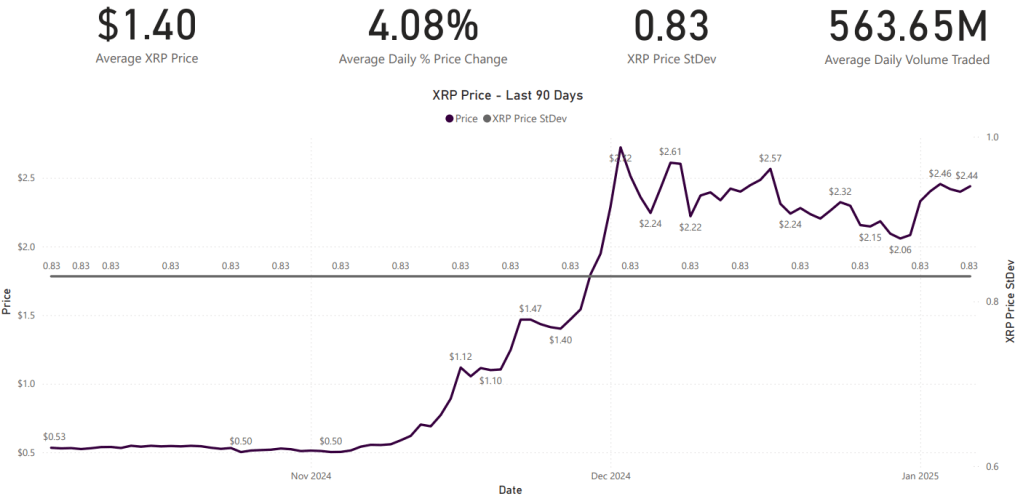
Date: 06 January 2025
Source: Investing.com
II. Network and Usage
Network Metrics
The Ripple Network (RippleNet) is a decentralised network of global banks and financial institutions that use a standard framework of payment rules to process real-time, trackable payments on-demand with minimal transaction costs. The key components that make up the network are:
- xCurrent – an enterprise-level software that enables banks to initiate and settle transactions. It’s like SWIFT but a lot faster and without the middlemen.
- xVia – a payment interface for businesses that send payments on behalf of a customer to each other globally across various networks in a transparent manner using a standard API connection. Using xVia allows businesses to gain access to a vast network of banks and payment providers that are also on RippleNet.
- On-Demand Liquidity (ODL) – formerly known as xRapid, this product helps illiquid pairs swap with each other despite low liquidity for them. This is done by using XRP, the native token of Ripple, to be the intermediate token between the pairs.
- CBDC platform – Mint, manage, transact, and destroy CBDCs on a single platform.
User Adoption
Smart Contracts and dApps
III. Comparison with Traditional Finance Alternatives
Cost-Benefit Analysis
Security and Trust
Accessibility and Inclusivity
IV. Future Utility
Roadmap and Development
Risks and Mitigations
Relevance
Disclaimer: This analysis is for informational purposes only and does not constitute financial advice. Readers are encouraged to conduct their own research and seek professional advice before making investment decisions.
References
Chong, J.A. (2024). What is Ripple XRP? How it’s Revolutionizing Finance. Available at: CoinBureau (Accessed: 06 January 2025).

 The BitLeaf
Leave a comment