
Unlocking Opportunities
Diving Into DePIN
Date of Publication
February 2025
Author
Charlie Kellaway
Reading Time
12 minutes

Introduction
In July 2024, the world experienced one of the largest technology outage events ever. CrowdStrike, a cybersecurity company, suffered a system failure that crashed Windows machines, causing global disruption and costing Fortune 500 companies $5.4bn [1]. Losses were not localised to Software and IT; Health, Banking and Aviation were heavily hit as effects rippled across interconnected industries.
For disruption to one company to cause global contagion is indicative of serious risks in current supply chains. At the time, CrowdStrike counted nearly 60% of Fortune 500 companies among its clientele and other infrastructure markets are similarly consolidated [2]. For example, the “Big Three” of cloud infrastructure – Amazon Web Service (AWS), Azure and Google Cloud – account for more than 60% of the market, with the rest of the competition stuck in the low single digits [3]. As CrowdStrike’s failure showed, overreliance on a few centralised entities presents financial and operational risks to global businesses that cannot be ignored.
Now, an innovative new architecture has emerged. Decentralised Physical Infrastructure Networks (DePINs) leverage blockchain technology to decentralise the control and management of physical devices, directly contrasting traditional setups. Instead of relying on one organisation, DePINs support infrastructure with numerous nodes across a network. Early models show potential to mitigate the risks of centralised failures.
This article provides a comprehensive overview of DePIN, presenting design principles and discussing utility. We highlight why this model, by leveraging the community, may be successful, but also consider the challenges stacked against it. We conclude that, fundamentally, DePIN may coordinate human activity in ways unachievable by centralised models. However, patience is needed to allow the most valuable projects to thrive.
Decentralised Physical Infrastructure Networks
Blockchain began with promises of decentralised money and peer-to-peer finance, but DePINs offer tangential utility [4]. By leveraging decentralised concepts, DePINs crowdsource physical infrastructure, such as computing power or data storage. Developers create a blockchain-based management system and incentivise global participants to contribute physical resource in exchange for token rewards [5]. Blockchain foundations are necessary to publicly and digitally record all contributions in a transparent and traceable ledger, so any user with sufficient resources can contribute and gain proportionate reward for their efforts. This creates a decentralised network of people sharing resources directly, allowing diverse markets to thrive without depending on intermediaries. DePINs also distribute ownership and governance of a project among network participants, offering a plausible solution to the constraints of centralised services.
It works as follows. Physical resources are represented as tokens, allowing them to be traded, used and shared [6]. Tokens also incentivise participants by rewarding them with assets for their contributions. The infrastructure is distributed, owned and operated collectively by all participants, so there is no single point of failure. Operationally, this should be more secure as a node can be quickly replaced if it experiences an outage. And the network leverages smart contracts to automate resource distribution and execute payments for services. For example, if a node fails, a smart contract can automatically reallocate to another provider within the network.
The potential utility is astounding, best illustrated with an example. Hivemapper, which sells high definition dashcams, is tackling Google Maps’ monopoly on geospatial mapping [7]. Google’s Street View can be months to years old, since it requires Google-owned cars to drive round and capture data [8]. It only shows imagery available on the day the image was taken. In contrast, Hivemapper’s operations create a far more current log of global roadways. Anyone can attach the camera to their rearview mirror, which maps roads as a user drives around. Hivemapper feeds these images into its global map, and a user, in exchange, is rewarded proportionately with HONEY tokens. By 2023, Hivemapper had mapped 5 million unique kilometres of road across 90 countries, and this has since swelled to 18 million unique kilometres, 428 million kilometres in total, to map 30% of the world’s roadways [9]. Hivemapper is now the fastest growing mapping company in history, expanding four times faster than Google Maps did in its early stages.
Alternatives are equally diverse (Table 1). Consider decentralised connectivity on Wi-Fi hotspots, like that built by Helium. Or decentralised exchange of compute and energy through Filecoin and Arkreen, respectively. DePINs can even support health, rewarding users for completing fitness routines that exchange data whilst promoting healthy lifestyles.
| Project | Sector | Description |
|---|---|---|
| Arkreen | Green Energy | Incentivises green energy providers to provide data on their energy plants, such as the capacity of their solar setup. Useful for providers and regulators who must access electricity data to build services or track usage. |
| DIMO | Mobility | Car owners are rewarded with DIMO token for providing relevant data on vehicles to other owners and manufacturers, including vehicle identity data, part availability and other information. |
| Filecoin | Data Storage | Records storage space contributed by providers and rewards contributors in FIL, while users pay a fee to lend storage and securely store their data. |
| Healthblocks | Healthcare | Users are rewarded in HEALTH tokens for completing quests or providing data to healthcare companies. |
| Helium | Wireless Networks | Sells hotspots and pays users HNT tokens for providing internet coverage, building a global IoT network. |
| Hivemapper | Geospatial Mapping | Users install a dashcam on their vehicles to contribute location data as they drive around and are rewarded with HONEY token relative to the areas covered. |
| NuNet | Compute Networks | AI-powered marketplace making dormant computing resources available to anyone. Providers are rewarded in NTX tokens, whilst companies and individuals can borrow available computing power for a fee. |
How can these businesses surmount the dominant market share of incumbent centralised leaders? Metcalfe’s Law states that a network’s value is proportional to the square of the number of nodes in the network, achieving non-linear, exponential growth [10]. Each DePIN highlighted above relies on an essential component: community engagement. Nodes are community members – people empowered by the network’s purpose. And each node provides value back to the network. As the community grows, more data and resource flow to the project and the infrastructure provides greater utility for an increasing user base. By leveraging the community, DePINs can unlock exponential coordination of human resource that could provide infrastructure faster and cheaper than otherwise possible.
The Importance of Community
A community is a large (possibly, global) group of individuals who are passionate about the purpose of an organisation and directly involved in its main functions [11]. Many centralised technology companies leverage communities to deliver resources for millions of users. Uber, for example, connects the physical resources of drivers – their vehicles – with users on a digital platform. Drivers are paid for providing a chauffeur service, attracting more drivers, so resources increase, and the user base grows accordingly. Everyone is aligned with the company purpose – “The best way to get wherever you’re going” – connecting users and drivers to enterprise success [12].
However, in centralised systems, the main functions are ultimately controlled by the central authority, not the community. Uber can impose demands, drop a driver from the network or amend fees structures without consultation. Drivers must pass certain requirements to obtain membership; even users may need to jump through various hoops to capitalise on resources. And the tangible components necessary to support services like Wi-Fi and data, like routers, hard drives and servers, are almost always provided by single entities [13]. So, infrastructure has, historically, been the domain of centralised corporates.
DePINs, however, subvert centralised authorities, changing the dynamics of data control. Applications range many sectors, from crowd-sourced geolocation mapping to shared energy, but always operate on blockchain, leaning into the fact that communities drive value creation. Regular people and small businesses can provide services, decreasing the cost of provision whilst simultaneously ensuring that services are accessible. Such scale of shared resource should increase the availability of a given service and mitigate disruptions (for example, if a single resource provider fails).
It is not hard to imagine that community-derived information may be able to scale human activity beyond that achievable through centralised models. Blockchain, at heart, is a communal technology, and communities enable DePINs to leverage peer-to-peer value creation. The crowd provides data to the network in exchange for tokens and, if the network offers increasing utility, more users will want tokens and contribute more value. Everyone wins. It would be destructive (though not impossible) to provide poor-quality resource since that would diminish the long-term value exchange. Instead, DePINs support local economies, each relevant for value exchange and economic operation between community members [14]. The result is a diverse collection of self-sufficient communities that increase the information resolution of the world.
Advantages and Challenges
As presented, DePINs support interactions by stimulating contribution and excel at generating and sharing data. Decentralisation creates open ownership, allowing new projects to challenge industries that have historically been dominated by a small set of powerful firms. Bottom-up collective ownership directly contrasts monopolies geared towards enriching company shareholders, reducing market barriers to increase competitiveness. It should be an advantageous approach that quickly shares knowledge to solve problems effectively.
The approach lowers operating costs, as DePINs can be self-sufficient. Contributors are responsible for maintaining their resources and are incentivised to do so if they want to earn rewards [15]. In line with Metcalfe’s Law, the network becomes more powerful as it grows: if the native token appreciates, rewards increase, attracting more contributors and investment. Marketing efforts are, therefore, almost autonomous. Tokens also maintain a balance between supply and demand. When demand is low, the value of a token decreases, and certain providers will want a lower workload or even become dormant. In high-demand scenarios, tokens appreciate, and the network can re-activate dormant resources to increase capacity without much effort. Waste is reduced and the system can find equilibrium.
So, aside from the cost to lay blockchain infrastructure, DePINs require relatively little funding. Each new contributor brings with him resource to build on the utility of the network. Contributors are rewarded proportionately, so there are opportunities for smaller businesses and entrepreneurs to participate in service provision and the network does not need to focus on shareholder value (a constraint afflicting centralised institutions). And decentralisation greatly reduces the risk of service disruptions. If one component fails, other nodes across the network can step in to provide the service. The approach can deploy quickly and securely. With lower operating costs, pricing models are expected to be cheaper, and the design should deliver quality services for the least possible cost. Consumers benefit as a result.
Of course, as with every technology, particularly emerging concepts, DePIN has its drawbacks. Community coordination is a key challenge. Who runs the organisation? Who coordinates its purpose and measures progress against it? Management and accountability are key, as community building takes time. DePINs depend on a progressive, valuable purpose to initiate community alignment; one that urges investors and providers to partake. Without this, it will fail to hit the exponential possibilities of community engagement. Therefore, DePIN builders must focus on providing resource to solve a genuine problem and reward contributors proportionately for providing valuable resource. Hivemapper cofounder, Ariel Seidman, put forward such a solution. If a road has previously been mapped, a contributor will be rewarded far less than if they provide images of a unique road. Ultimately, stakeholders hold the DePIN accountable, so projects must focus on delivering value and rewarding proportionately [16].
Once the community starts growing, scalability becomes an issue. Scalability is a critical challenge for blockchain generally – as users increase and the network expands, the volume of transactions will also increase [17]. This problem may be particularly acute for DePIN since there is reliance on connectivity to physical constructs. To support energy transmission, Wi-Fi provision or data transfer, it is anticipated that transaction times and fees will rise.
One way around this is to focus on interoperability. State transitions between different blockchain networks are touted as key for utility and scalability, supporting the transfer of code, data, assets, intellectual property and more between different chains. Since DePINs are built on multiple layers (Fig. 1), compatibility between, for example, a governance layer and the Ethereum Virtual Machine would allow users to communicate and share applications between Ethereum and the DePIN. Not only would this expand the network, but it would support scalability, allowing transactions to shift to different chains during congestion. However, current interoperability solutions are limited to specific blockchain ecosystems or accompanied by high cross-chain costs. DePINs will largely suffer scalability issues in the short-term as a result.
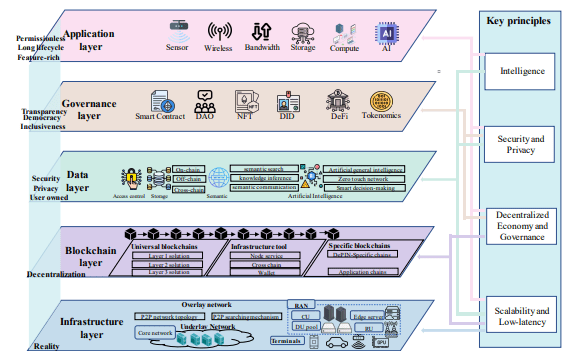
Lastly, as with all blockchain projects, DePIN faces regulatory challenges. Most jurisdictions are still defining their position on blockchain and decentralised assets, so there is uncertainty for entrepreneurs and investors. DePIN will require a tailored framework that differs from, for example, decentralised finance (DeFi) or meme coin treatment. The anonymous nature of contributors makes it challenging for regulators to monitor the flow of assets, so items like tax treatment will be contentious. Accordingly, regulators must find a balance to prevent criminals from leveraging DePIN for money laundering activities and encourage safe, valuable innovation. And this must be achieved soon – regulatory uncertainty makes it difficult for entrepreneurs to build projects for fear of retroactive penalties [18].
Patience Is Key
DePIN is a niche area, currently overshadowed by more established categories of blockchain technology. Attention, whether from developers, users or media, is largely focused on blockchain infrastructure, stablecoins, DeFi and gaming, and private investment reflects this.
In the final quarter of 2024, venture capital (VC) activity overwhelmingly favoured stablecoins, blockchain infrastructure and Web3, allocating $600mm or more to these segments (Fig. 2) [19]. 13 of 39 monitored segments raised over $100mm across the quarter. DePIN, however, raised the 9th lowest sum – less than $25mm across four deals. Noting that crypto-focused VCs invested $3.5bn in total, less than 0.7% went to DePIN.

Patience, therefore, is needed. With less outside investment, fewer projects may be turbocharged to succeed and DePINs will instead need to rely on the organic community growth that their business model is founded on. With time, and as communities grow, investment should follow. Hivemapper and Helium are two promising, fast-growing projects that have raised $18mm and $200mm in 2022, respectively, and Helium breached 100,000 subscribers midway through 2024 [20, 21]. Others will get there. But they must adhere to the principle of rewarding value provision proportionately. Doing so will attract the users, resources and capital that allows a project to flourish.
Closing Remarks
DePINs capitalise on the communal aspect of blockchain technology to coordinate human activity. They reward contributors for supplying resources, democratising the ownership and governance of physical infrastructure, and show the potential to grow exponentially as the value of a network increases. By applying the mechanics of DePIN, entrepreneurs and investors can unlock diverse markets on much smaller budgets, opening the door for faster and cheaper service provision than previously possible.
In theory, DePINs could change the very dynamics of how software and hardware are supported. Current systems are heavily centralised, even monopolised, but this model is risky and has been shown to disrupt global businesses if stressed. DePINs could mitigate such risks, automatically replacing individual resource providers with other nodes in the network to ensure continuous service provision.
That said, the concept is still young. Scalability and interoperability challenges afflict all blockchain segments, and the changing regulatory landscape introduces further uncertainty. DePINs need tailored treatment, and it may be some time before the appropriate formula is realised. In addition, investment trends show that this segment is currently a low priority for private capital. To succeed, projects must find a purpose and a way to proportionately reward value provision. This approach can encourage a community to grow and realise DePIN’s potential.
[1] Parametrix. (2024). CrowdStrike’s Impact on the Fortune 500. Available at: Parametrix (Accessed: 29 January 2025).
[2] Cyber Event Analysis. (2024). A Closer Look: Unveiling the Global Impact of CrowdStrike Event. Available at: GuyCarpenter (Accessed: 03 February 2025).
[3] Richter, F. (2024). Amazon Maintains Cloud Lead as Microsoft Edges Closer. Available at: Statista (Accessed: 03 February 2025).
[4] Nakamoto, S. (2008). Bitcoin: A Peer-to-Peer Electronic Cash System. Available at: bitoin.org (Accessed: 10 January 2024).
[5] Vilkenson, T. (2024). Decentralized physical infrastructure network (DePIN), explained. Available at: Cointelegraph (Accessed: 27 January 2025).
[6] Bialas, S. (2024). DePIN Crypto: How It’s Revolutionizing Infrastructure in Web3. Available at: Ulam Labs (Accessed: 03 February 2025).
[7] McBride, S. (2024). Don’t buy meme coins. Buy DePin cryptos instead. Available at: Medium (Accessed: 09 January 2025).
[8] Google-Contributed Street View Imagery Policy. Available at: Google (Accessed: 31 January 2025).
[9] bee maps. (2023). Outpacing Google: Hivemapper Tops 5 Million Unique Kilometers Mapped. Available at: bee maps (Accessed: 27 January 2025).
[10] Fisk, P. (2020). Metcalfe’s Law explains how the value of networks grows exponentially. Available at: Peter Fisk (Accessed: 30 January 2025).
[11] Ismail, S., Diamandis, P.H., & Malone, M.S. (2023). Exponential Organizations EXO 2.0. Powell: Ethos Collective.
[12] Naude, D. (2017). A list of Massive Transformative Purposes. Available at: Medium (Accessed: 29 January 2025).
[13] Agbo, J. (2024). What Is the Decentralized Physical Infrastructure (DePIN) Narrative in Crypto? Available at CoinGecko (Accessed: 27 January 2025).
[14] Swan, M. (2015). Blockchain. Sebastopol, CA: O’Reilly Media, Inc.
[15] Lin, Z., et al. (2024). Decentralized Physical Infrastructure Network (DePIN): Challenges and Opportunities. Available at: arXiv (Accessed: 27 January 2025).
[16] Seidman, A. (2024). The Key to Building Sustainable DePIN. Available at: CoinDesk (Accessed: 03 February 2025).
[17] Sanka, A.I. & Cheung, R.C. (2021). A systematic review of blockchain scalability: Issues, solutions, analysis and future research. Journal of Network and Computer Applications, 195, 103232.
[18] Basi, A. (2025). Tokenizing infrastructure and the need for stronger regulation in DePIN. Available at: TradingView (Accessed: 03 February 2025).
[19] Thorn, A., & Parker, G. (2025). Crypto & Blockchain Venture Capital – Q4 2024. Available at: Galaxy (Accessed: 03 February 2025).
[20] Crypto fundraising.
[21] Lubale, N. (2024). HNT defies market trend with a 21% surge fueled by Helium ecosystem growth. Available at: Cointelegraph (Accessed: 03 February 2025).
 The BitLeaf